
UV digital printing ink is widely used in advertising, packaging, labeling, building materials, and home furnishings due to its versatility and eco-friendly properties. With growing market demand, UV ink has become a “dark horse” in the printing industry. This guide explains seven technical indicators to evaluate UV ink quality effectively. For more details on digital printing solutions and SAVEN Ink product range, you can explore our dedicated pages.
I. Raw Material Quality
Key raw materials: resin, monomer, photoinitiator.
1. Resin
-
Flexible inks: Polyurethane acrylate (PUA), for leather and soft film
-
Hard inks: Epoxy acrylate (EA), for metals and glass
-
Neutral inks: Polyester acrylate (PEA), for advertising, home decoration, PVC
Indicators: imported resins (BASF, Allnex), solid content >95%, uniform molecular weight
2. Monomer
Affects viscosity, fluidity, odor; high-quality UV ink uses multi-monomer blends
3. Photoinitiator
Curing speed <1 sec; depth 80–120 μm
II. Formulation and Process
-
Color paste: particle size 150–300 nm, no agglomerates
-
Filtration: 0.2–0.5 μm, no gel breakage at 180–300 MPa
-
Stabilization: prevents nozzle clogging, stratification, premature crosslinking
III. Color & Optical Performance
-
Color gamut: 5–20% higher than OEM
-
ΔE <2, high saturation, adjustable gloss 3–80
-
Advertising: focus on vividness and density
-
Packaging: focus on color stability and batch consistency
IV. Outdoor Weather Resistance
Outdoor performance is determined by photoinitiator stability, pigment UV resistance, and resin anti-yellowing. For industry standards on UV ink testing, refer to SGIA UV Ink Technology or EPA ink regulations for environmental compliance guidelines.
-
QUV: 500–1000h no fading
-
Anti-yellowing: Δb* <2
-
Temperature cycling: -20°C to 80°C, no cracks
V. Surface Properties
-
Surface tension: 22–28 mN/m (flatbed), 28–34 mN/m (flexible)
-
Adhesion: industrial grade 0–1
-
Scratch resistance: 2H–4H
-
Flexibility: ASTM bend test
VI. Chemical Resistance
-
Solvents: alcohol, cleaners, sweat, salt spray, diesel, weak acids/bases
-
Must withstand 2000 wipes, 48–72h salt spray, 500–2000 alcohol wipes
VII. Equipment Compatibility
-
Compatible: Epson I3200/S3200, Ricoh G5/G6, Konica KM1024i/1024A, Kyocera, Seiko 1024
-
Stable viscosity, matched surface tension, pH neutral/slightly acidic, continuous 8–12h printing
Conclusion
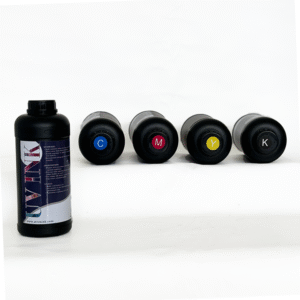
High-quality UV ink requires stable raw materials, excellent adhesion, smooth flow, vivid colors, weather resistance, and wide nozzle compatibility. SAVEN Ink has 24 years of experience in digital printing, producing stable and high-performance UV inks exported globally.